Concrete remains the backbone of construction projects, from small DIY patios to large commercial buildings. Its price in 2026 is influenced by supply chain fluctuations, material costs, labor charges, and regional demand. Accurate knowledge of concrete prices helps you avoid budget overruns and ensures your project stays on track.
Factors Affecting Concrete Prices
Several key factors influence concrete costs. Understanding them helps you make informed decisions and plan your budget.
1. Type of Concrete
Concrete comes in various types, including ready-mix, high-strength, lightweight, and decorative concrete. Each type has different material requirements, which directly impact costs.
2. Project Size and Volume
Larger projects require more concrete, but bulk orders sometimes come with discounts. Smaller quantities can cost more per cubic yard or per bag.
3. Labor Costs
Concrete installation requires skilled labor for mixing, pouring, and finishing. Labor costs vary by region and project complexity, which can affect the overall price.
4. Regional Availability
Concrete prices differ based on proximity to suppliers, transportation costs, and local demand. Urban areas often have higher prices due to increased labor and material costs.
5. Additional Additives and Reinforcements
Additives like fibers, plasticizers, or waterproofing agents, as well as steel reinforcements, increase concrete prices but improve performance and durability.
6. Seasonal Demand
During peak construction seasons, concrete prices may rise due to higher demand. Early planning can help you lock in lower rates.
Concrete Prices by Type
Different types of concrete are priced differently. Here’s a comprehensive table showing average 2026 prices per cubic yard:
| Concrete Type | Price Range (USD per cubic yard) | Best Use Case |
|---|---|---|
| Standard Ready-Mix | $120 – $150 | Driveways, sidewalks |
| High-Strength Concrete | $150 – $200 | Commercial structures, bridges |
| Lightweight Concrete | $140 – $180 | Roofing, floors, insulation |
| Decorative Concrete | $180 – $250 | Patios, stamped floors |
| Fiber-Reinforced Concrete | $160 – $220 | Pavements, industrial floors |
| Self-Consolidating Concrete | $200 – $300 | Complex forms, high-quality finishes |
Regional Variations in Concrete Costs
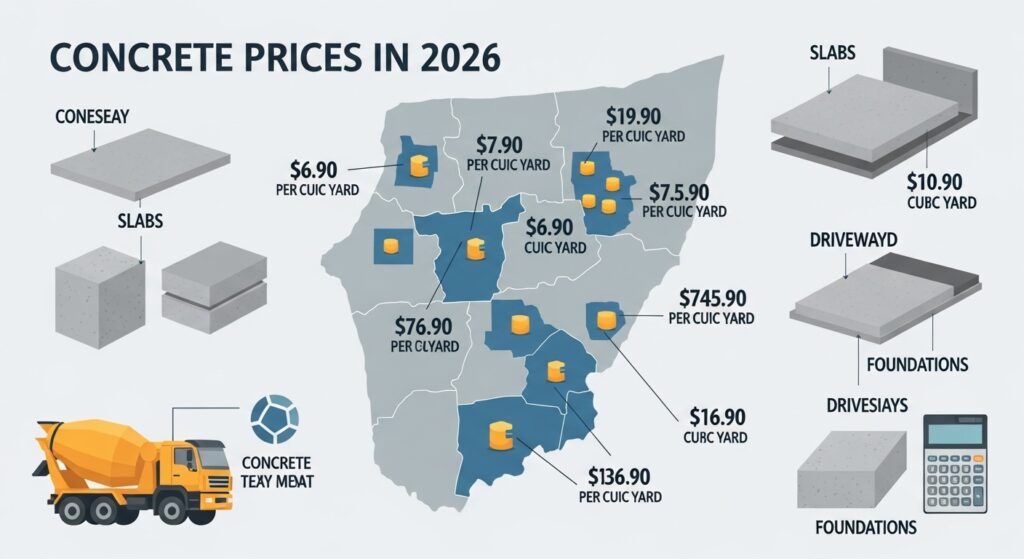
Concrete prices differ across regions due to supply chain, labor, and material costs. Here’s an overview of 2026 regional pricing trends:
| Region | Average Price (USD per cubic yard) | Notes |
|---|---|---|
| Northeast US | $130 – $160 | High labor and transportation costs |
| Southeast US | $120 – $150 | Moderate pricing due to local supply |
| Midwest US | $110 – $140 | Lower due to local production of materials |
| West Coast US | $140 – $180 | Expensive due to high demand and urban projects |
| Southern Canada | $120 – $150 | Varies with urban centers |
| Europe | $150 – $220 | High-quality standards and labor costs |
These regional differences are important when budgeting for projects across states or countries.
Average Cost of Concrete in 2026
The average concrete cost in 2026 is roughly $130 – $200 per cubic yard, depending on type and location. Small residential projects using standard ready-mix concrete are at the lower end of this range, while commercial or specialty concrete can exceed $250 per cubic yard.
Additional Costs to Consider:
- Delivery fees
- Labor and installation
- Additives or reinforcement materials
- Waste or overage (usually 5-10%)
How to Calculate Concrete Costs
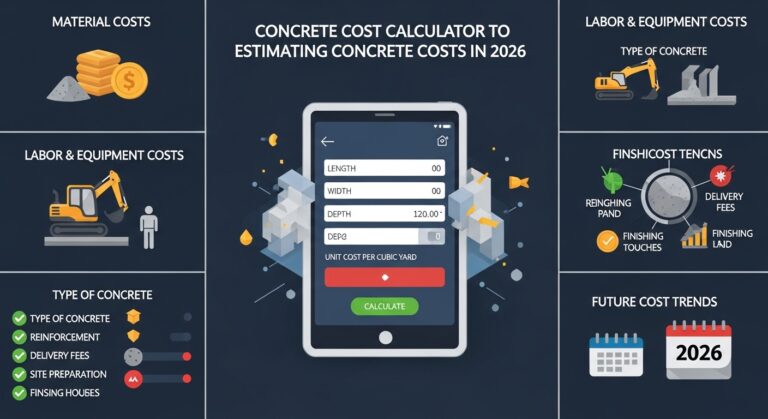
Using a Concrete Cost Calculator makes it easier to estimate project costs. Here’s a simple step-by-step method:
- Measure Project Dimensions – Length, width, and depth in feet or meters.
- Calculate Volume – Multiply dimensions to get cubic feet, then convert to cubic yards (1 cubic yard = 27 cubic feet).
- Choose Concrete Type – Select standard, high-strength, or decorative concrete.
- Include Additives and Reinforcements – Fibers, steel, or waterproofing agents.
- Add Labor and Delivery Costs – Include local rates for installation.
- Include Waste – Add 5-10% extra for spillage or cutting.
For example, a 10 ft × 10 ft × 0.5 ft slab:
Volume = 10 × 10 × 0.5 = 50 cubic feet → 50 ÷ 27 ≈ 1.85 cubic yards.
Estimated cost for standard concrete at $140 per cubic yard:
1.85 × 140 ≈ $259.
Using an online concrete cost calculator simplifies this process for any project.
Tips to Save Money on Concrete Projects
- Plan Early – Ordering in advance can avoid seasonal price spikes.
- Buy in Bulk – Large orders often reduce the price per cubic yard.
- Compare Suppliers – Get quotes from multiple suppliers.
- Minimize Waste – Accurate measurements prevent excess material purchase.
- DIY for Small Projects – Reduce labor costs by mixing and pouring small batches yourself.
- Consider Alternative Concrete Types – Lightweight or fiber-reinforced concrete may save money on installation and long-term maintenance.
FAQs About Concrete Prices
Q1: What is the average cost of concrete per cubic yard in 2026?
A: The average cost ranges from $130 – $200 per cubic yard depending on type, location, and project size.
Q2: How much does decorative concrete cost compared to standard concrete?
A: Decorative concrete can cost $180 – $250 per cubic yard, higher than standard ready-mix concrete ($120 – $150).
Q3: Does concrete price vary by region?
A: Yes, labor, transportation, and local demand cause regional differences. The West Coast is typically more expensive than the Midwest.
Q4: How do I calculate concrete cost for my project?
A: Multiply the project volume (in cubic yards) by the concrete type cost, then add labor, delivery, and waste. Using an online concrete cost calculator makes this easy.
Q5: Can I reduce concrete costs?
A: Yes, by planning early, buying in bulk, comparing suppliers, and reducing waste.
Conclusion
Understanding concrete prices in 2026 is essential for homeowners, contractors, and construction managers. Costs vary depending on type, region, labor, and project size. By using a concrete cost calculator and considering tips to save money, you can plan your construction projects efficiently while avoiding budget overruns.
Whether you are working on driveways, patios, slabs, foundations, or walls, staying informed about the latest concrete prices ensures that your projects are cost-effective and completed on time.