Concrete Calculator, Volume, Bags & Cost Estimator
Use our concrete calculator to estimate the concrete volume your project needs, the number of bags required, and the expected material cost. Enter your measurements, choose imperial or metric units, and calculate concrete for slabs, footings, walls, columns, patios, and other common shapes.
Your Concrete Estimate
Volume by Shape
Shape Comparison
How to Use Our Concrete Calculator
Using this concrete calculator takes only a few steps. Enter your project dimensions, choose the correct shape and units, and review the estimated concrete volume, bag quantity, and material cost.
Choose Your Measurement Units
Select Imperial (feet and inches) or Metric (meters and centimeters) based on how you measured your project. Keep each dimension in the unit shown beside its input field to avoid calculation errors.
Select Your Concrete Shape
Choose the shape that matches your project, such as a slab, footing, wall, column, or post hole. Different shapes require different dimensions, so selecting the correct option helps produce a more relevant volume estimate.
Enter the Project Dimensions
Enter the required measurements, such as length, width, thickness, height, or diameter, depending on the selected shape. Measure carefully and double-check your figures before calculating, especially when the concrete will fill a prepared form or excavation.
Add the Number of Identical Shapes
If your project includes several shapes with the same dimensions, enter their total quantity where the calculator allows it. For sections with different dimensions, add them separately so each one contributes the correct amount to the combined estimate.
Enter Concrete Prices and Bag Information
Enter the price per concrete bag, its stated yield, or the ready-mix price per cubic yard, depending on the options available in the tool. Check the product packaging or supplier quote because bag yields, prices, and delivery charges can vary.
Add a Waste Allowance
Include an appropriate allowance for minor measurement differences, spillage, and uneven surfaces. The right percentage depends on your project and site conditions, so use it as a planning adjustment rather than a substitute for accurate measurements.
Calculate and Review Your Results
Run the calculator and check the estimated concrete volume, quantity before and after waste, bag requirements, and material cost. Before placing an order, confirm the measurements and estimated quantity with your concrete supplier, particularly for large or structural pours.
What Can You Calculate With Our Concrete Calculator?
Our concrete calculator supports different project shapes to help estimate concrete volume, bag quantities, and material costs. Whether you’re planning a patio, foundation, wall, or set of steps, select the shape that matches your project and enter its dimensions to get an estimate.
Concrete Slab Calculator for Floors, Patios, and Driveways
Use the concrete slab calculator to estimate the amount of concrete required for rectangular slabs, garage floors, patios, and driveways. Enter the slab’s length, width, and thickness to calculate its volume and estimate the material needed for your project.
Concrete Footing Calculator for Foundations
A concrete footing calculator helps estimate concrete for foundation footings and other rectangular base sections. Enter the length, width, depth, and number of identical footings to calculate their combined concrete requirements.
Concrete Wall Calculator
A concrete wall calculation uses the wall’s length, height, and thickness to estimate its volume. This is useful when planning retaining walls, foundation walls, or other concrete wall sections, although reinforcement and structural design require separate consideration.
Concrete Column Calculator
Use the column option to estimate concrete for square or rectangular columns by entering their cross-sectional dimensions and height. For round columns, use the circular-column or tube option if available, since their volume depends on the radius and height.
Circular Concrete Slab Calculator
A circular concrete slab calculator helps estimate concrete for round pads, circular patios, and similar projects. Enter the diameter and thickness; the calculation uses the circle’s area and the slab depth to determine the required volume.
Concrete Post Hole Calculator
A post hole concrete calculator estimates concrete for holes used to set fence posts and similar supports. Enter the hole diameter, depth, and quantity to estimate the total volume, then check the recommended fill requirements for your particular post installation.
Concrete Tube and Sonotube Calculator
Use the tube option to estimate concrete for cylindrical forms, including Sonotubes used for piers and supports. You’ll generally need the tube’s diameter, height, and quantity to calculate the combined volume.
Concrete Stairs Calculator
Concrete stairs have a more complex shape than a simple slab, so their concrete volume depends on the dimensions of the steps and the overall stair profile. Select the stairs option if supported by the calculator and enter the requested measurements; complicated stair designs may require separate calculations.
Concrete Curb and Gutter Calculator
The curb and gutter option helps estimate concrete for edging, drainage channels, and similar installations. The result depends on the cross-sectional shape and the length of the section, so use the dimensions requested by the tool.
Triangular Concrete Calculator
A triangular concrete calculation is useful for triangular pads, sloped sections, and other triangular-prism shapes. The estimate requires the triangle’s base and height, along with the concrete depth or length of the prism.
Custom Concrete Shape Calculator
Some projects don’t fit a standard slab, footing, or column shape. If the calculator provides a custom-shape option, use it for supported irregular layouts and confirm that the entered dimensions accurately represent the area being filled.
How Much Concrete Do You Need?
The amount of concrete you need depends on the shape, dimensions, and thickness of your project. A concrete volume calculator helps estimate the required volume before you order ready-mix concrete or purchase bags. Measure each section carefully, calculate its volume, and add the results together if your project contains multiple shapes.
How to Calculate Concrete Volume
For a rectangular slab, footing, or similar shape, multiply the length by the width and thickness. Make sure all three measurements use the same unit before multiplying.
Formula: Concrete volume = Length × Width × Thickness
For example, a slab measuring 10 feet long, 10 feet wide, and 4 inches thick has a volume of approximately 33.33 cubic feet before any waste allowance. Convert the 4-inch thickness to feet by dividing it by 12.
Concrete Volume Formula for a Slab
To calculate concrete for a slab, multiply its length by its width and thickness. This method works for many rectangular patios, floors, garage slabs, and walkways.
For measurements in feet:
Slab volume (cubic feet) = Length × Width × (Thickness in inches ÷ 12)
To convert cubic feet to cubic yards, divide the result by 27. This is useful when ordering ready-mix concrete, which is commonly sold by the cubic yard in the United States.
Concrete Volume Formula for Footings and Foundations
For a rectangular footing, multiply its length, width, and depth. If the project includes several footings with identical dimensions, multiply the volume of one footing by the number of footings.
For a continuous footing or foundation with changing dimensions, calculate each section separately and add the volumes together. Structural dimensions should come from the approved plans rather than an online calculator.
Concrete Volume Formula for Columns and Round Holes
Round columns and cylindrical post holes use a different formula because their cross-section is circular.
Formula: Volume = π × Radius² × Height
The radius is half the diameter. Use consistent units for the radius and height, then convert the result into cubic feet, cubic yards, or cubic meters as needed.
How to Calculate Concrete for Multiple Areas
If your project includes a slab, separate footings, and several post holes, calculate each shape individually. Add the volumes to find the combined concrete requirement, then apply an appropriate waste allowance if needed.
This method is generally more reliable than treating a project with different dimensions as one large rectangle.
How to Convert Cubic Feet to Cubic Yards
To convert cubic feet into cubic yards, divide the volume by 27 because one cubic yard contains 27 cubic feet.
Formula: Cubic yards = Cubic feet ÷ 27
For example, 54 cubic feet equals 2 cubic yards. Use the unrounded volume when performing further calculations, and round the final ordering quantity according to your supplier’s requirements.
How to Convert Cubic Yards to Cubic Feet
Multiply the number of cubic yards by 27 to convert it into cubic feet.
Formula: Cubic feet = Cubic yards × 27
For example, 3 cubic yards equals 81 cubic feet. This conversion is useful when comparing a ready-mix order with bagged concrete, whose product yield is often listed in cubic feet.
How to Calculate Concrete in Cubic Meters
For metric measurements, multiply the length, width, and thickness in meters to calculate the volume in cubic meters.
Formula: Volume (m³) = Length (m) × Width (m) × Thickness (m)
If your dimensions are in centimeters, convert them to meters first by dividing each measurement by 100. Keeping the units consistent helps prevent errors when switching between metric and imperial measurements.
Concrete Volume Calculation Example
Suppose you need concrete for a slab that is 12 feet long, 10 feet wide, and 4 inches thick.
- Convert the thickness: 4 ÷ 12 = 0.333 feet.
- Calculate the volume: 12 × 10 × 0.333 = approximately 40 cubic feet.
- Convert to cubic yards: 40 ÷ 27 = approximately 1.48 cubic yards.
The slab requires about 1.48 cubic yards of concrete before waste allowance. The final order quantity may be higher depending on site conditions, and the example does not include the cost of materials, delivery, or labor.
How Many Bags of Concrete Do I Need?
To estimate how many bags of concrete you need, calculate your project’s concrete volume and divide it by the yield printed on the bag. A concrete bag calculator makes this easier by estimating the number of bags required for your dimensions and selected bag size. The final quantity depends on the volume of your project, the concrete mix you choose, and any extra material allowed for waste.
How to Calculate the Number of Concrete Bags
First, calculate the concrete volume in cubic feet. Then divide that volume by the yield per bag and round the result up to the next whole bag, because you cannot purchase a fraction of a bag.
Bags needed = Concrete volume ÷ Yield per bag
For example, if your project requires 33.3 cubic feet of concrete and each bag yields 0.60 cubic feet, the calculation is 33.3 ÷ 0.60 = 55.5. You would need 56 bags before adding any waste allowance. Always use the yield stated on your chosen product’s packaging or technical data sheet.
Concrete Bags Needed for Different Project Sizes
The number of bags increases with the size and thickness of your project. A small post hole may need only a few bags, while a large patio or garage slab can require dozens or hundreds.
To estimate your requirements, measure each section, calculate its volume, and use the bag yield for your selected mix. If your project has different shapes—such as a slab with separate footings—calculate each part and add the volumes together before working out the total bag count.
40 lb, 50 lb, 60 lb and 80 lb Concrete Bags
Concrete mixes are sold in different bag sizes, and each size provides a different volume of mixed concrete. The table below shows common example yields for standard bagged concrete mixes; actual yields can vary by product, so check the manufacturer’s specifications before buying.
| Bag weight | Example yield | Bags per cubic yard |
|---|---|---|
| 40 lb | 0.30 cu ft | 90 |
| 50 lb | 0.375 cu ft | 72 |
| 60 lb | 0.45 cu ft | 60 |
| 80 lb | 0.60 cu ft | 45 |
A larger bag generally means fewer bags to carry and mix for the same project, but it also weighs more per bag. Choose a size that is practical to handle and available in the concrete mix suitable for your project.
How Much Concrete Does One Bag Make?
The amount of concrete produced by one bag is called its yield. For example, a standard 80 lb bag may yield about 0.60 cubic feet, while a standard 60 lb bag may yield about 0.45 cubic feet. These are examples, not universal values for every concrete product.
To find the yield for your chosen mix, check the bag label or the manufacturer’s product data sheet. Specialty mixes, including fast-setting or high-strength products, may have different instructions and coverage.
How to Estimate Concrete Bag Requirements for a Slab
For a rectangular slab, multiply its length by its width and thickness to calculate the volume. Convert the thickness into the same unit as the length and width before multiplying, then divide the resulting volume by the yield per bag.
For example, a 10 ft × 10 ft slab with a thickness of 4 inches requires approximately 33.3 cubic feet of concrete before waste. Using a mix with a yield of 0.60 cubic feet per bag, that works out to 56 bags after rounding up. Your actual bag count will depend on the product yield and whether you add a waste allowance.
How to Account for Waste When Buying Concrete Bags
The calculated volume represents the concrete needed for the measured shape; it may not account for spillage, uneven ground, or small differences between planned and actual dimensions. You can include a waste allowance to reduce the risk of running short during the pour.
56 bags × 1.10 = 61.6, rounded up to 62 bags
Treat 10% as an example rather than a fixed rule—the appropriate allowance depends on site conditions and the accuracy of your measurements. Check your supplier’s advice before ordering.
How Much Does Concrete Cost?
The cost of concrete depends on how much you need, the type of mix you choose, and the price charged by your supplier. Our concrete cost calculator helps estimate material expenses by using your calculated volume and the prices you enter. You can estimate the cost of ready-mix concrete or bagged concrete and account for additional charges separately when the calculator supports them.
H3: How to Calculate the Total Cost of Concrete
To estimate concrete cost, multiply the quantity you need by its unit price. For ready-mix concrete, the quantity is usually measured in cubic yards or cubic meters; for bagged concrete, calculate the number of bags and multiply by the price per bag.
Ready-mix cost = Concrete volume × Price per unit of volume
Bagged concrete cost = Number of bags × Price per bag
For example, if you need 2 cubic yards of ready-mix concrete and your supplier quotes $150 per cubic yard, the material cost is $300 before delivery or other fees. Use your actual supplier quote because prices vary by location, mix specification, order size, and supplier. <Cite refs={[“turn224204search1″,”turn224204search3”]}/>
H3: Concrete Cost per Cubic Yard
Ready-mix concrete is commonly priced by the cubic yard in the United States. To estimate the material cost, multiply the number of cubic yards required by your supplier’s price per cubic yard, then add any applicable delivery or small-load fees.
For example, 3 cubic yards at a quoted rate of $160 per cubic yard would cost $480 for the concrete itself. This is an example calculation, not a current market quote; confirm the rate and fees directly with your supplier.
H3: Concrete Cost per Cubic Meter
In metric markets, concrete may be quoted per cubic meter. Multiply the required volume in cubic meters by the supplier’s price per cubic meter to estimate the material cost.
Concrete cost = Required volume (m³) × Price per m³
Make sure the volume and price use the same unit. If a quote is given per cubic yard but your estimate is in cubic meters, convert one of them before calculating.
H3: Concrete Cost per Square Foot
Concrete cost per square foot can help with early budgeting for slabs, patios, driveways, and floors. However, the rate depends heavily on slab thickness, concrete mix, site preparation, reinforcement, finishing, and whether the estimate covers materials only or the complete installed job.
For a material-only estimate, calculate the volume first and then divide the concrete material cost by the slab’s area. This gives an estimated material cost per square foot for that specific thickness and mix—not a universal price for every concrete project.
H3: Concrete Cost per Square Meter
The same approach works for projects measured in square meters. Divide the estimated concrete material cost by the slab’s area in square meters to calculate the material cost per square meter.
Remember that thickness affects the amount of concrete needed. Two slabs with the same surface area can have different material costs if their thicknesses or concrete specifications differ.
H3: Cost of Bagged Concrete vs. Ready-Mix Concrete
Bagged concrete and ready-mix concrete have different cost structures. Bagged mix is purchased by the bag and mixed on-site, while ready-mix is delivered in bulk and commonly priced by volume. The more economical option depends on your project size, local prices, delivery charges, and the time and labor involved in mixing bags.
For a fair comparison, calculate the same concrete volume using both options. Include the actual bag yield and bag price, plus the ready-mix price and any delivery or short-load fees. Don’t compare the bag price alone with the ready-mix price per yard; compare the total estimated cost for the quantity you need. <Cite refs={[“turn224204search0″,”turn224204search3”]}/>
H3: How to Estimate the Cost of a Concrete Slab
To estimate a slab’s material cost, calculate its volume using length × width × thickness, making sure all dimensions use the same unit. Convert the result to the unit used by your supplier, then multiply by the quoted price.
For example, a 10 ft × 10 ft slab with a thickness of 4 inches contains about 1.23 cubic yards of concrete before waste. At an illustrative price of $150 per cubic yard, the material would cost about $185 before any waste allowance, delivery, or other charges.
H3: How to Estimate Concrete Driveway and Patio Costs
Start by measuring the driveway or patio’s length, width, and planned thickness. If the area has multiple sections, calculate each section separately and add the volumes before applying your supplier’s price.
The concrete material estimate is only one part of the budget. Site excavation, base preparation, reinforcement, forms, finishing, labor, and access for the delivery truck can affect the total project cost. Obtain local quotes if you need an installed-cost estimate.
H3: How to Estimate Concrete Foundation Costs
Foundation concrete costs depend on the dimensions and number of footings, foundation walls, piers, or other concrete sections in the plans. Calculate each shape separately, combine the volumes, and multiply by the relevant supplier price.
Keep the material estimate separate from excavation, reinforcement, formwork, waterproofing, labor, and engineering requirements. Use approved construction plans for structural dimensions, and confirm the order quantity with the contractor or concrete supplier.
H3: Additional Costs to Include in Your Budget
The concrete material price may not represent the full amount you pay for a project. Depending on the site and supplier, additional expenses can include:
- Delivery and short-load fees: Charges may apply when the order is below a supplier’s minimum economical load.
- Concrete pumping and equipment: A pump or other equipment may be needed when the pour location is difficult to reach.
- Labor and finishing: Placing, leveling, smoothing, and curing work can add to the budget.
- Site preparation and excavation: Removing soil, preparing a base, and building forms may be necessary before the pour.
- Reinforcement and rebar: The project design may require steel reinforcement or other materials.
- Waste and unexpected conditions: Spillage, uneven ground, or changes in actual dimensions can increase material needs.
Ask your supplier and contractor which charges are included in their quotes. Enter fees separately in the calculator when those fields are available, and avoid adding a charge twice if it’s already included in the quoted price.
Concrete Bags vs. Ready-Mix Concrete: Which Is Cheaper?
Choosing between bagged concrete and ready-mix concrete depends on the size of your project, local prices, delivery fees, and how quickly the concrete needs to be placed. A concrete cost calculator can help compare the material cost of both options using your project volume and actual supplier prices. Bagged concrete may be practical for small jobs, while ready-mix can be more convenient for larger pours that need to be completed in one go.
Bagged Concrete vs. Ready-Mix Concrete
Choosing between bagged concrete and ready-mix depends on your project size, available equipment, labor, and delivery costs. Compare the practical differences before deciding which option suits your job.
When Is Bagged Concrete the Better Choice?
Bagged concrete is often a practical option for small repairs, fence-post holes, minor patches, and projects where a concrete truck cannot easily reach the work area. You can buy only the number of bags you need, and unopened bags may be stored according to the manufacturer’s instructions.
However, mixing bags takes time and physical effort. Before choosing this option, use a concrete bag calculator to estimate the required quantity and multiply the number of bags by your local price per bag. For larger pours, also consider the time, equipment, water supply, and labor needed to mix and place the concrete consistently.
Small repairs, fence posts, patching, and limited-access areas.
When Is Ready-Mix Concrete More Practical?
Ready-mix concrete is delivered to your site in a truck and is often more practical for large slabs, driveways, foundations, and other projects that require a substantial volume. It reduces the need to mix individual bags on-site and can help a crew place the concrete within a planned schedule.
The total price may include more than the quoted rate per cubic yard or cubic meter. Ask the supplier about minimum order quantities, delivery charges, short-load fees, waiting time, and any site-access requirements before comparing quotes.
Large slabs, driveways, foundations, and substantial pours.
How to Compare the Cost of Bags and Ready-Mix
To make a fair comparison, calculate the same concrete volume for both options and use prices from your local suppliers. Include the bag yield, number of bags, ready-mix price, and any applicable delivery or small-load fees.
| Cost factor | Bagged concrete | Ready-mix concrete |
|---|---|---|
| Material price | Price per bag × number of bags | Price per cubic yard or cubic meter × volume |
| Delivery | Depends on how you collect or arrange delivery | Supplier delivery charges may apply |
| Small orders | Buy the number of bags required | Minimum-load or short-load fees may apply |
| Labor | Bags must be mixed and moved on-site | Concrete arrives mixed, but still needs placing and finishing |
| Leftover material | Unopened bags may be stored as directed | Excess delivered concrete may be difficult to reuse |
The lower material price does not always mean the lower overall project cost. For an accurate decision, compare the complete quoted costs and consider how much work each option requires.
What Is a Ready-Mix Concrete Short-Load Fee?
A short-load fee is an additional charge that may apply when your order is smaller than the supplier’s standard delivery load. The fee varies by supplier and service area, so don’t assume that every company uses the same minimum quantity or pricing method.
For a small project, this charge can change the comparison between bagged and ready-mix concrete. Ask your supplier for the minimum order, delivery fee, and short-load policy, then include those charges in your estimate where applicable.
How Much Extra Concrete Should You Order?
When estimating how much concrete to order, calculate the exact volume of your project first, then add a suitable concrete waste allowance. Extra concrete can help account for small measurement errors, uneven ground, spillage, and variations in the prepared forms. The amount you need depends on the shape of the pour and site conditions, so a fixed percentage should be treated as a planning estimate rather than a rule for every project.
H3: What Is a Concrete Waste Allowance?
A concrete waste allowance is extra material added to the calculated volume to reduce the risk of running short during a pour. For example, if your slab requires 2 cubic yards before waste, adding a 10% allowance increases the estimated order quantity to 2.2 cubic yards.
This allowance does not replace careful measurements. Check the dimensions of your forms or excavation, and consider whether the base is level and the sides are secure before deciding how much extra concrete to include.
H3: How to Calculate Extra Concrete
To calculate the amount of extra concrete, multiply the base volume by the waste percentage expressed as a decimal. Then add that amount to the original volume.
Formula:
- Extra concrete = Base volume × Waste percentage
- Total concrete to order = Base volume × (1 + Waste percentage)
For example, a project requiring 3 cubic yards with a 10% allowance needs an additional 0.3 cubic yards. The adjusted estimate is 3.3 cubic yards, before considering the supplier’s order increments or minimum delivery requirements.
H3: How Much Waste Allowance Should You Add?
A concrete calculator with waste can help you compare different allowances, but the right amount depends on the job. A carefully measured slab with well-prepared forms may need a different allowance from post holes drilled into uneven or loose ground.
A 5% or 10% allowance is sometimes used for preliminary planning, but neither percentage is suitable for every project. Inspect the site, measure the actual forms, and ask your concrete supplier or contractor for guidance when the pour is large or the consequences of running short are significant.
H3: Concrete Volume Before and After Waste
Keep the original volume separate from the adjusted order quantity so you can see how much concrete the project geometry requires and how much extra has been added for planning.
| Base concrete volume | Waste allowance | Extra concrete | Adjusted volume |
| 1 cubic yard | 5% | 0.05 cubic yards | 1.05 cubic yards |
| 2 cubic yards | 10% | 0.20 cubic yards | 2.20 cubic yards |
| 5 cubic yards | 10% | 0.50 cubic yards | 5.50 cubic yards |
| 8 cubic yards | 15% | 1.20 cubic yards | 9.20 cubic yards |
These are mathematical examples, not recommended allowances for every job. Confirm the appropriate quantity and the supplier’s delivery requirements before placing an order.
H3: Does Concrete Waste Allowance Affect Bag Quantity and Cost?
Yes. Adding extra volume can increase both the number of bags and the estimated material cost. For bagged concrete, divide the adjusted volume by the yield per bag and round up to the next whole bag. For ready-mix concrete, multiply the adjusted volume by the supplier’s unit price, then account for delivery charges or minimum-order fees.
Use the actual yield printed on your chosen product’s packaging. If the supplier sells concrete in specific increments, the amount you order may differ from the calculated volume.
How to Calculate Concrete for Common Projects
Concrete Calculators for Different Projects
Different concrete projects require different measurements, even when the same basic volume formula applies. A concrete calculator can help estimate the material needed for a driveway, patio, sidewalk, garage floor, or foundation by using the dimensions of each section. Before calculating, confirm the planned thickness and measure the actual area rather than relying only on typical project sizes.
Length, width, thickness and shape determine your concrete volume.
Concrete Driveway Calculator
A concrete driveway calculator helps estimate the concrete volume needed for a driveway based on its length, width, and thickness. For a rectangular driveway, multiply these dimensions after converting them to the same unit, then convert the result to cubic yards or cubic meters for ordering.
Driveways with widened parking areas, curves, or separate sections should be divided into manageable shapes. Calculate each section separately and add the volumes together. Remember that the concrete estimate does not automatically include excavation, the gravel base, reinforcement, finishing, or labor.
Concrete Patio Calculator
A concrete patio calculator estimates how much concrete is required for an outdoor sitting area, garden patio, or backyard entertainment space. Measure the patio’s length and width, then use the planned slab thickness to calculate its volume.
For an L-shaped patio or one with different-width sections, split the layout into rectangles, calculate each section, and add the results. Include a suitable waste allowance after calculating the base volume, and confirm the finished dimensions and base preparation before ordering.
Concrete Sidewalk and Walkway Calculator
A concrete sidewalk calculator can estimate concrete for footpaths, garden walkways, and paths leading to an entrance. The main measurements are the total length, width, and planned thickness of the walkway.
If the path changes width or direction, calculate its sections separately instead of treating the entire layout as one rectangle. For long paths, also consider joints, the prepared base, drainage, and any local requirements that affect construction.
Concrete Garage Floor Calculator
A concrete garage floor calculator helps estimate the volume needed for a garage slab using its length, width, and thickness. If the garage floor has a separate apron or adjoining pad, calculate those areas individually and include them in the total only if they are part of the same pour.
The appropriate slab thickness and reinforcement depend on the intended use, ground conditions, loads, and local building requirements. Use the construction plans or professional advice to determine these specifications rather than selecting thickness based on a volume estimate alone.
Concrete Foundation and Footing Calculator
A concrete foundation calculator helps estimate concrete for foundation slabs, strip footings, and other foundation sections with known dimensions. For rectangular footings, multiply length by width and depth; for multiple identical footings, multiply the volume of one footing by the number required.
Foundation work is structural, so the calculator should be used for quantity estimation—not to decide footing dimensions or load-bearing capacity. Follow the approved plans and confirm the final order quantity with the contractor or supplier.
Concrete Shed Base and Equipment Pad Calculator
A concrete pad calculator is useful for estimating concrete for a shed base, generator pad, hot-tub base, or other small equipment platform. Enter the pad’s length, width, and thickness, making sure the measurements reflect the actual concrete dimensions.
The base requirements can differ according to the equipment’s weight, ground conditions, and manufacturer’s installation instructions. Check these requirements before pouring, especially when the pad supports heavy equipment or machinery.
Concrete Post Hole Calculator
A concrete post hole calculator estimates the volume needed to fill cylindrical holes for fence posts, deck supports, and similar installations. The main inputs are the hole diameter, depth, and number of holes; the cylindrical volume formula uses the hole’s radius and depth.
The amount of concrete needed around each post depends on the hole size and how the post is installed. If the calculator estimates the entire hole volume, remember that a post placed inside it displaces some of that volume. Follow the fence or structural design requirements when determining hole dimensions and concrete placement.
Concrete Column and Pier Calculator
A concrete column calculator can estimate concrete for round, square, or rectangular columns when their dimensions are known. Rectangular columns use length × width × height, while cylindrical columns use π × radius² × height.
For several identical columns or piers, calculate one unit and multiply by the total quantity. Confirm the dimensions and reinforcement requirements from the relevant plans, as an online volume calculation does not determine structural strength or suitability.
Concrete Steps Calculator
A concrete steps calculator helps estimate concrete for solid poured steps, small stairways, and entrance stoops. The volume depends on the stair width, riser height, tread depth, and number of steps, so the shape needs more care than a simple rectangular slab.
For a stepped profile, calculate the individual rectangular sections or use a suitable stair-volume method, making sure overlapping sections are not counted twice. Complex stair designs and structural details should be checked against the plans before ordering concrete.
Concrete Wall Calculator
A concrete wall calculator estimates the volume of poured concrete using the wall’s length, height, and thickness. For a simple rectangular wall, multiply those three dimensions; for walls with openings, deduct the appropriate opening volumes if the calculation method supports them.
Retaining walls and foundation walls may also require reinforcement, drainage, and engineered dimensions. The calculator estimates material quantity only and should not replace structural design or site-specific advice.
Understanding Concrete and Its Materials
Concrete is a widely used construction material made by combining cement, aggregates, and water in suitable proportions. It can be poured into forms, shaped to fit a project, and hardened into a solid structure. Understanding the basic materials helps you choose the right concrete mix and estimate the quantity needed for your slab, driveway, footing, or other project.
What Is Concrete?
Concrete is a composite building material made from cement, water, fine aggregate such as sand, and coarse aggregate such as gravel or crushed stone. When water reacts with cement, it forms a binding paste that holds the aggregate particles together as the concrete hardens.
Concrete is used for foundations, sidewalks, patios, driveways, floors, columns, and many other structures. For quantity planning, a concrete calculator estimates the volume required from your project’s dimensions, while the concrete mix specification determines the materials used to produce that volume.
What Is the Difference Between Concrete and Cement?
Cement and concrete are related, but they are not the same thing. Cement is a binding ingredient, while concrete is the finished mixture of cement, water, and aggregates.
For example, buying a bag of cement alone does not provide all the materials needed to make ordinary concrete. You also need the appropriate aggregates and water, or you can choose a preblended concrete mix that already contains the dry ingredients.
What Is a Concrete Mix?
A concrete mix is the combination of ingredients used to produce concrete with the required workability, strength, and durability. Its composition may include cementitious materials, fine and coarse aggregates, water, and optional admixtures that modify certain properties.
The right mix depends on how and where the concrete will be used. A mix suitable for a small garden project may not meet the requirements for a structural footing or a driveway carrying heavy vehicles. Follow the project specifications or manufacturer’s instructions when selecting a mix.
Common Types of Concrete
Concrete is available in different forms for different construction needs. Common options include:
- Ready-mix concrete: Batched at a concrete plant and delivered to the job site, often used for larger pours.
- Preblended bagged concrete: A dry mixture packaged for smaller projects and mixed with water according to the instructions.
- Reinforced concrete: Concrete used with steel reinforcement where the design requires it.
- Precast concrete: Concrete cast and hardened in a factory or casting yard before being transported to the installation site.
- Fiber-reinforced concrete: Concrete containing fibers to help modify properties such as crack control or toughness, depending on the product and design.
These options are not interchangeable for every application. Choose a product based on the project’s requirements, rather than volume or price alone.
Bagged Concrete Mixes and Their Uses
Bagged concrete mix is a convenient option for small repairs, fence-post installations, stepping stones, and other projects where ordering a ready-mix truck may not be practical. Many preblended products contain cement and aggregates, so you only need to add the specified amount of water.
Bag sizes and concrete yields vary by manufacturer and product. Use the yield printed on the packaging to estimate how many bags you need, and follow the mixing instructions carefully. For larger slabs or driveways, compare the total bag cost and mixing effort with a ready-mix quote before deciding.
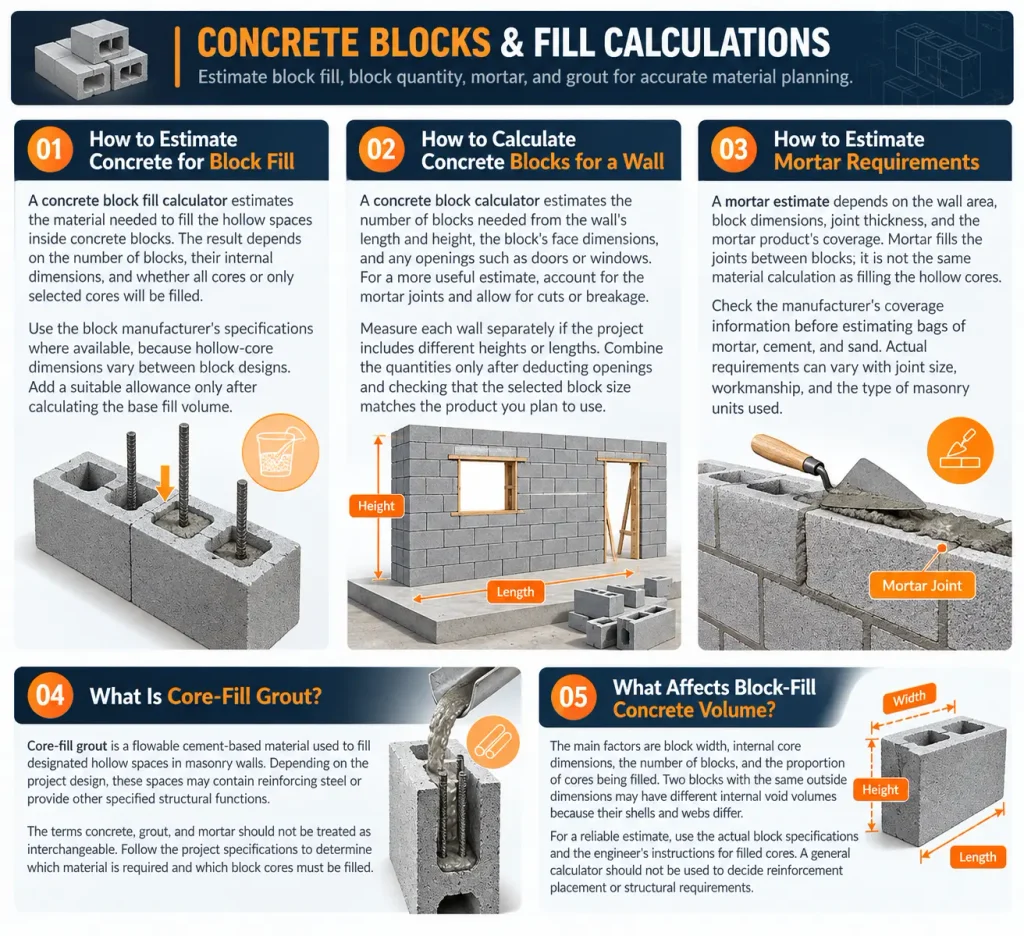
Concrete, Mortar and Grout: What’s the Difference?
Concrete, mortar, and grout are cement-based materials, but each serves a different purpose.
- Concrete contains cementitious material, water, and fine and coarse aggregates. It is commonly used for slabs, foundations, and other structural or non-structural elements.
- Mortar generally contains a binder, water, and fine aggregate. It is commonly used to bond bricks or masonry blocks and fill the joints between them.
- Grout is a flowable material used to fill spaces, joints, or designated block cores, depending on its formulation and intended application.
For estimating purposes, use the calculation appropriate to the material. A concrete volume estimate should not automatically be used as a mortar or grout estimate because their compositions, applications, and coverage differ.
How Is Concrete Made and Mixed?
Concrete is made by combining cement, sand, gravel or crushed stone, and water in the proportions required for the selected mix. Proper measuring and mixing help produce a consistent material that can be placed and finished as intended. For smaller projects, bagged concrete mix is often convenient, while larger projects may use ready-mix concrete delivered directly to the site.
Basic Ingredients of Concrete
The basic ingredients of concrete are cement, water, fine aggregate such as sand, and coarse aggregate such as gravel or crushed stone. Cement reacts with water and binds the aggregate particles together as the concrete hardens.
Some concrete mixes also contain supplementary cementitious materials or admixtures to achieve specific performance requirements. The exact ingredients depend on the product and its intended use, so check the manufacturer’s specifications before mixing.
The Role of Cement, Sand and Gravel
Each ingredient has a different role in concrete. Cement and water form a paste that binds the mixture, sand fills smaller spaces between particles, and gravel or crushed stone provides the coarse aggregate.
The quality, size, grading, and moisture content of the aggregates can affect the concrete’s workability and performance. The proportions should therefore follow the specified mix rather than an arbitrary estimate.
Why Concrete Mix Specifications Matter
Concrete mix specifications describe the proportions and performance requirements for a particular application. These may include strength, workability, durability, aggregate characteristics, and water content.
A mix suitable for a garden path may not be appropriate for a structural footing or a load-bearing slab. Follow the approved mix design and project specifications for structural work. A concrete calculator can estimate the required volume, but it cannot determine the correct structural mix or guarantee the finished concrete’s strength.
Why You Should Follow the Manufacturer’s Mixing Instructions
When using bagged concrete, follow the instructions on the packaging for the required water quantity, mixing method, and working time. Add water gradually and measure it carefully instead of adding extra water simply to make the mixture easier to spread. Excess water can reduce the strength and durability of the hardened concrete.
If using a concrete mixer, stay within its recommended capacity and mix until the ingredients have a uniform appearance and workable consistency. Wear waterproof gloves and eye protection when handling cement-based products, and avoid direct contact with wet concrete.
Concrete Calculator Formula and Examples
A concrete calculator formula helps you work out how much concrete a project requires using its dimensions. Whether you’re planning a slab, footing, or another rectangular structure, the basic calculation uses length, width, and thickness. Understanding these concrete calculations helps you check your results before ordering concrete and estimate the quantity in cubic feet, cubic yards, or cubic meters.
Concrete Volume Formula
The concrete volume formula depends on the shape you’re calculating. For a rectangular slab or footing, multiply its length by its width and thickness. Keep all measurements in the same unit before calculating the volume.
Formula:
If you need to know how to calculate concrete, first measure the length and width of the area, then measure its thickness or depth. Convert the measurements into consistent units before multiplying them.
For example, if a slab is 10 feet long, 10 feet wide, and 4 inches thick, convert the thickness to feet by dividing 4 by 12. The calculation is:
This gives you the concrete volume before adding any waste allowance.
Example: Calculating Concrete for a 10 × 10 ft Slab
A concrete slab calculator can help estimate the amount of concrete required for a patio, shed base, or small floor slab. Let’s calculate a slab measuring 10 feet long, 10 feet wide, and 4 inches thick.
- Length: 10 feet
- Width: 10 feet
- Thickness: 4 inches, or 0.333 feet
- Volume: 10 × 10 × 0.333 = approximately 33.33 cubic feet
To convert this into cubic yards, divide the result by 27.
Therefore, the slab requires approximately 1.23 cubic yards of concrete before any waste allowance. Confirm the dimensions and supplier’s ordering requirements before placing an order.
Example: Calculating Concrete for a Footing
Concrete footings require a volume calculation based on their length, width, and depth. Suppose a rectangular footing is 8 feet long, 2 feet wide, and 1 foot deep.
If the project includes several identical footings, multiply the volume of one footing by the total number of footings. Use the approved construction plans for the footing dimensions, especially when the footings support a structure.
Example: Estimating Concrete Bags and Material Cost
To estimate bag quantities, divide the total concrete volume by the yield of one bag. For example, if a project requires 33.33 cubic feet and each bag produces 0.60 cubic feet, the calculation is:
Round up to 56 bags before adding any waste allowance.
To estimate the material cost, multiply the number of bags by the price per bag. If each bag costs $6, the estimated cost is:
This is an illustrative calculation, not a current price quote. Check the actual bag yield and local price of the product you plan to purchase.
Example: Adding a Waste Allowance
A concrete calculator waste allowance helps account for minor measurement differences, spillage, and uneven surfaces. Suppose the calculated concrete volume is 2 cubic yards and you choose a 10% allowance for planning.
The adjusted estimate is 2.20 cubic yards. The appropriate allowance depends on the site and accuracy of the measurements, so don’t treat 10% as a fixed requirement for every project.
Example: Converting Cubic Feet to Cubic Yards
A cubic yard calculator concrete calculation is useful when your measurements are in cubic feet but your supplier sells ready-mix concrete by the cubic yard.
One cubic yard equals 27 cubic feet.
For example, 81 cubic feet divided by 27 equals 3 cubic yards. If you already know the concrete volume in cubic yards, multiply it by 27 to convert it back into cubic feet.
Always complete unit conversions before estimating bag quantities or comparing supplier prices. This helps keep your volume estimate consistent and reduces the risk of ordering too much or too little concrete.
What Affects the Cost of a Concrete Project?
The total cost of a concrete project depends on the amount of concrete required, the selected mix, local supplier prices, and the work needed to prepare and finish the site. A concrete cost estimator helps you plan your budget by calculating the required volume and applying the prices you enter. Your final cost may differ from the estimate because delivery charges, labor, site conditions, and other expenses vary between projects.
01 Project Size and Concrete Thickness
The size and thickness of a project directly affect how much concrete you need. A larger slab requires more material than a smaller one, while a thicker slab increases the volume even when the surface area stays the same.
A concrete slab cost calculator can help estimate material expenses by using the slab’s length, width, thickness, and the price per unit of concrete. Measure the actual project dimensions carefully before calculating the volume. For irregular areas, calculate each section separately and combine the results.
02 Concrete Mix and Strength Requirements
The selected concrete mix can affect the material price. Different projects may require different strength grades, aggregate sizes, durability characteristics, or specialist mixes. A mix suitable for a garden path may not meet the specifications required for a structural foundation or a driveway carrying heavy vehicles.
When estimating the cost, use the price for the mix specified for your project. Choosing a cheaper mix without checking its suitability can lead to problems that cost more to correct later.
03 Local Supplier Prices
Concrete prices vary by location, supplier, product specification, and order quantity. Two suppliers serving the same area may provide different quotes because of their batching costs, available materials, delivery arrangements, and pricing policies.
A concrete cost calculator can estimate your material expenses when you enter a supplier’s quoted price. Use current local quotes rather than relying on a single online price as a guaranteed rate. If you’re comparing suppliers, check that each quote covers the same concrete specification and quantity.
04 Delivery Distance and Minimum Loads
Ready-mix concrete is delivered to the site by truck, so the distance from the batching plant and the size of your order can affect the total expense. Some suppliers charge additional fees for orders below their standard delivery quantity.
Before ordering, ask about delivery charges, minimum loads, short-load fees, waiting time, and any restrictions on truck access. These costs can make a noticeable difference to a small project, even when the concrete’s quoted price per cubic yard appears reasonable.
05 Labor and Site Preparation
The concrete itself is only one part of the project budget. Site preparation may involve excavation, removing unsuitable soil, leveling the ground, preparing a gravel base, and installing formwork before the pour begins.
Labor costs also depend on the project’s size, complexity, accessibility, and finishing requirements. If you want to estimate the complete project expense rather than materials alone, obtain local contractor quotes and keep labor and preparation costs separate from the concrete material estimate.
06 Pumping, Equipment and Site Access
Some projects require a concrete pump or additional equipment because the pour location is difficult to reach. This may apply to elevated slabs, restricted backyards, large foundations, or sites where a delivery truck cannot approach the forms directly.
Equipment rental, pumping services, and access restrictions can increase the overall budget. Confirm these requirements before placing your concrete order, particularly when the site has narrow entrances, limited working space, or long distances between the truck and the pour location.
07 Reinforcement, Formwork and Finishing
Reinforcing steel, wire mesh, formwork, and finishing materials may add to the cost of a concrete project. The requirements depend on the design, intended use, soil conditions, and applicable building specifications.
For example, a driveway may require different reinforcement and finishing work from a simple garden path. Follow the project plans when determining reinforcement and thickness. Include these expenses separately if your calculator estimates concrete materials only.
08 Waste and Unexpected Site Conditions
Uneven ground, inaccurate measurements, spillage, and variations in excavation dimensions can increase the amount of concrete required. Adding an appropriate waste allowance helps account for some of these uncertainties, although the right amount depends on the project and site conditions.
Calculate the base volume first, then apply your chosen allowance to estimate the adjusted quantity. Remember that additional concrete also increases the material cost and may affect delivery charges if the order moves into a different pricing category.
Common Concrete Calculation Mistakes to Avoid
Using the Wrong Measurement Units
One of the most common mistakes when calculating concrete is mixing inches, feet, meters, and centimeters in the same formula. For example, entering a slab thickness of 4 inches as 4 feet will produce a much larger volume than the project requires.
When you calculate concrete, make sure all dimensions use compatible units before multiplying them. If your length and width are in feet and the thickness is in inches, divide the thickness by 12 to convert it into feet.
For ordering ready-mix concrete, you may also need to convert the result into cubic yards. Divide cubic feet by 27 to obtain cubic yards. A concrete calculator in yards can simplify this conversion when ordering concrete by the cubic yard.
Forgetting to Include Concrete Thickness
Length and width determine the surface area, but thickness determines the volume of concrete required. A calculation that uses only the surface area will not tell you how much concrete to order.
For example, a 10 ft × 10 ft slab that is 4 inches thick requires approximately 33.33 cubic feet, or 1.23 cubic yards, of concrete before adding waste. If the same slab is 6 inches thick, the volume increases to 50 cubic feet, or approximately 1.85 cubic yards.
Use a concrete slab calculator to estimate the volume using the actual length, width, and planned thickness. For structural slabs, follow the approved plans rather than choosing the thickness based only on a calculator result.
Entering the Wrong Shape Dimensions
Using incorrect dimensions or selecting the wrong shape can lead to an inaccurate concrete estimate. A rectangular slab, cylindrical post hole, circular pad, and triangular section each require a different volume formula.
Before you calculate concrete quantity, measure the actual space that will contain the concrete. For an irregular project, divide the layout into simpler shapes, calculate each section separately, and add the results together.
Check the dimensions carefully before using a concrete volume calculator, particularly when the project includes sloping ground, thickened edges, steps, or sections with different depths.
Forgetting the Quantity of Repeated Shapes
Another common mistake is calculating the volume of one footing, post hole, or column without multiplying it by the total number required.
For example, if one footing requires 2 cubic feet of concrete and your project contains 12 identical footings, the total volume is 24 cubic feet before waste. You must account for all 12 footings rather than ordering material for just one.
When you calculate how much concrete you need, enter the correct quantity of identical shapes if your calculator provides a quantity field. If the shapes have different dimensions, calculate each group separately and combine the results.
Confusing Square Feet With Cubic Feet
Square feet measure area, while cubic feet measure volume. They cannot be used interchangeably when estimating concrete.
For example, a 100-square-foot slab with a thickness of 4 inches has a volume of approximately 33.33 cubic feet. The area alone does not tell you the amount of concrete required.
If you are working with metric measurements, remember that square meters measure area and cubic meters measure volume. A square meter to cubic meters concrete calculator calculation must account for thickness to convert the area into a volume.
Always check whether your result represents square feet, cubic feet, cubic yards, square meters, or cubic meters before ordering material.
Forgetting Waste and Spillage
The calculated concrete volume represents the dimensions entered into the formula. It does not automatically account for spillage, uneven ground, inaccurate measurements, or variations in the prepared forms unless a waste allowance is included.
For example, a project requiring 2 cubic yards of concrete with a 5% allowance would need an estimated 2.1 cubic yards. The appropriate allowance depends on site conditions and measurement accuracy, so do not assume that one percentage suits every project.
Calculate the base volume first, then use the waste setting in your concrete calculator if available. Avoid adding the same allowance twice by manually increasing your dimensions and applying a separate waste percentage to the adjusted result.
Using an Incorrect Bag Yield
Concrete bags do not all produce the same volume. The yield depends on the product and bag size, so using an assumed yield can result in ordering too many or too few bags.
For example, if your project requires 33.33 cubic feet and the selected concrete mix yields 0.60 cubic feet per bag, you would need approximately 56 bags before adding waste. A different product yield would produce a different bag count.
Use a concrete bag calculator with the yield specified on your chosen product’s packaging. Round fractional bag quantities up to the next whole bag, then account for any appropriate waste allowance.
Ignoring Delivery and Additional Charges
An accurate volume calculation does not guarantee an accurate project budget. Ready-mix suppliers may charge delivery fees, short-load fees, or additional amounts for waiting time and special equipment. These charges vary by supplier and location.
If you are estimating the cost of concrete, distinguish the material price from the total delivered cost. Enter the quoted price per cubic yard or cubic meter into your concrete cost calculator, and include additional charges separately where the tool allows it.
Before placing an order, confirm the concrete specification, minimum order quantity, delivery charges, and any other applicable fees with your supplier. This helps you avoid unexpected costs even when the estimated concrete volume is correct.
How Accurate Is a Concrete Calculator?
A concrete estimator can calculate the required concrete volume accurately when you enter the correct dimensions and select the appropriate shape. However, the actual amount needed on-site may differ because of uneven ground, measurement errors, variations in thickness, spillage, and material waste. A concrete estimate should therefore be treated as a planning figure, not a guarantee of the exact quantity your project will use.
What the Calculator Can Estimate
A concrete calculator can estimate the volume of concrete required for a project using its dimensions. Depending on the tool’s features, it may also calculate bag quantities, convert cubic feet into cubic yards or cubic meters, and estimate material costs using the prices you enter.
These calculations are useful for planning a slab, driveway, patio, footing, or other concrete project. The result depends on the measurements and inputs provided, so check that the dimensions, units, and project shape match the actual work.
What Factors Affect Calculation Accuracy?
Several factors can cause the actual concrete requirement to differ from the calculated result:
- Measurement errors: Incorrect length, width, or depth changes the calculated volume.
- Uneven ground: Low spots or variations in excavation depth can increase the quantity required.
- Thickness variations: A slab that is thicker than planned needs more concrete.
- Waste and spillage: Some material may be lost during mixing, transport, pumping, or placement.
- Incorrect bag yield: Different bagged products can produce different volumes.
- Shape complexity: Curved, stepped, or irregular projects may need to be divided into smaller shapes for a more reliable estimate.
For better results, measure carefully, calculate irregular sections separately, and add an appropriate waste allowance based on the site conditions.
Can You Trust an Online Concrete Calculator?
An online concrete estimator is useful for preliminary planning when its formulas, units, and assumptions match your project. It can help you compare quantities and prepare for a supplier quote, but it cannot inspect the site or verify whether your measurements reflect the actual excavation and forms.
Before ordering, double-check your dimensions and confirm the estimated quantity with your concrete supplier. For structural projects, use the approved plans to determine the required concrete specifications and dimensions.
Why Can Two Concrete Calculators Give Different Results?
Two calculators may produce different estimates because they use different bag yields, waste allowances, rounding rules, or shape formulas. One tool may display only the calculated volume, while another may include extra material for planning.
Compare the inputs and assumptions before deciding which result is appropriate. Make sure both calculators use the same dimensions, units, concrete bag yield, and waste percentage. If the results still differ significantly, check the calculations manually or ask your supplier to review the quantity.